Air date: Oct
5, 2012 to Mar 29, 2013
Studio: Bones + Aniplex
Episode number: 24
Score: 9/10
Zetsuen no Tempest has a special place in my
heart. It was my second favourite series of its season, and surprisingly
pleasurable to watch. Let me set it straight right off the bat - with
regard to this series, I am biased, for various reasons. First and foremost,
because Fuwa Aika resembles a character of my own making. Secondly because the flashbacks
and backstory were absolutely delicious. Last but not the least, because
anything inspired by Shakespeare, even if lightly, tends to have a dramatic
tone hard to find anywhere else. I could keep listing proof of my partiality. But
that’s beside the point. The point is - do not expect an objective review. Read
at your own risk.
Attention: This review is not spoiler-free!
Story
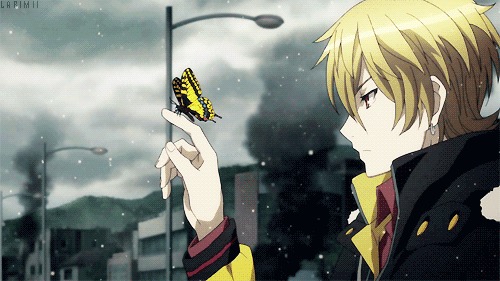 Fuwa Mahiro, a teenager whose sister was recently murdered, can't deal with the injustice of her loss while the murderer is still unknown. After finding a wooden doll, he gets involved with Kusaribe Hakaze, a magician that is estranged on an island. All around, strange things are happening; people are succumbing to Black Iron Syndrome while giant fruits appear from the ground, and Hakaze needs Mahiro's help to save the world.
This could be a very typically shounen premise if not for the connections between Mahiro, Yoshino and Aika. The very first episode you are shown animosity between Aika and Yoshino in every flashback you get. You see Yoshino looking at his phone and going to school even though Mahiro, his friend, is missing. Even once they're reunited, Mahiro takes every chance he gets to tell Yoshino that he and Aika didn't get along. Despite the fact that Mahiro doesn't care about this world that illogically killed Aika, Yoshino decides to help him for the sake of saving the world. Yet, at the very end of the episode, there's a repetition of the flashback with Aika on Mahiro's bike, now seen from Yoshino's perspective. That's when you realize she's smiling at him. You realize that she's speaking ill of him to Mahiro at the same time they're saying goodbye behind his back. And you come to terms with the fact that Yoshino has been staring at one of her pictures on his cellphone ever since she died.
From then on, all the flashbacks are clearer and you start to see the Shakespearean relationships going on. Yoshino keeps the secret that he and Aika were dating from Mahiro. Mahiro likes Aika, his stepsister, but doesn't realize it. It was pretty obvious that at some point all these things were going to come out. I just wanted to be there when it happened.
Arguably, that first 10-out-of-10 impression
was slightly attenuated by the main plot, which isn't as interesting for me as the
character interactions. Now, don’t get me wrong. It stands up pretty well on
its own and it’s a driver for everything that happens. It’s important. It might
even be the most interesting part for some people. But it wasn't the bit I was
looking forward to, after the first episode, no - the true delight of this
series lied in the main character's relationships. I was in for feelings
of sadness, warmth and cuteness, and the more I got those flashbacks,
the more I wanted them. It was a brilliant strategy to feed these juicy
bits slowly to the audience, amidst more common action. That kept me on the edge of my seat.
Characters
Since characters are such a capital aspect of this series, it was logically one of the things I paid most attention to. Soon I realized that there's a huge gap between the main characters and the side characters, which is development. I suppose the same happens with most series, where main characters change and are added depth as the story progresses, whilst the side characters are there as a utility more than as people. That is to say, they keep their role more or less the same way for the whole running time. While this doesn't diminish the enjoyment or quality of the show per say, it does make it hard to care for side characters. Sure, some look cool, witty or amusing, but they're there to fill in the gaps, and most of them don't work well as stand-alone characters. The only one I can recall that made me feel more than indifference was sister Yamamoto, because she has a strong (as in pushy) personality, which leaves a far stronger mark than the Kusaribe clan characters. The other side character with some potential, Junichiro, appeared too little to leave more than a fleeting impression.
Why isn't this enough of a flaw to lower my opinion of this series? Mostly, because I don't think most series need every character to be good. I love when that happens as much as everyone else, but realistically, most series have a small cast of really great characters, and a bigger cast of average ones. And I think that's okay, as long as the characters given most air-time are well-rounded and interesting. Such is this case. It would improve with better side characters, yes, but there's no need for them since the main ones are more than enough for the job.
Aika is amazing. It's widely agreed that she has a nasty personality, but it's the kind of nasty that I love. She's a strong female character, she's flirty, takes the lead, and decisive. She teases Yoshino as well as Mahiro, sometimes very meanly, and is perfectly aware of what she's doing. Nevertheless, she's also a dreamer, she believes in causality and logic, and recites Shakespeare on a daily basis, which means that she's not nasty because she's stupid or superficial. There are many layers to Aika, some of which are only revealed by the end of the series, and in there you can find kindness and independence, cute moments and straightforward ones, responsibility towards the world as the Magician of Exodus, cleverness, and a very human will to connect with those two boys. She's the best character of the series, in my eyes, and my only regret is that she is dead since the very first episode, and will not live again. You can share her past, but it's silly to pray for a future.
Hakaze is more typical, hence she doesn't shine as much. She needs help, but she's strong and smart all the same, perfectly fit to be the head of the clan. She does what she can by herself, still she doesn't have issues with relying on other people to do what she can't. At the same time, she falls hopelessly in love, she wavers and is a bit naïve. She struggles. I won't deny she has her charm, and certainly is easier for most people to relate to.
As for Mahiro and Yoshino, they're extremely interesting to watch whether on their own, with Aika and with each other. Mahiro surprised me with the maturity he has in spite of appearing selfish at first. I thought he was going to hit Yoshino when he learned he was Aika's mystery boyfriend, but my prediction was far off. More than anyone else, he has a process of discovery and acceptance going on until the very last moment. Yoshino is smart and collected but he's also wounded, suffering in silence. He can think his way out of difficult discussions and be eloquent. Still, the times I like Yoshino the most are when he shows a bit more of himself, like when he's around Mahiro.
 Personally, I love the art-style used in
Zetsuen no Tempest. While it’s not particularly distinctive or revolutionary, it
is not overdone. Everything feels smooth and pretty. The animation is
consistent and the type of perspective used in some scenes adds up to the
drama. Particularly Mahiro, Aika, Hakaze and Yoshino, the people you’re
supposed to care about the most, stand out as the best designed characters.
Personally, I love the art-style used in
Zetsuen no Tempest. While it’s not particularly distinctive or revolutionary, it
is not overdone. Everything feels smooth and pretty. The animation is
consistent and the type of perspective used in some scenes adds up to the
drama. Particularly Mahiro, Aika, Hakaze and Yoshino, the people you’re
supposed to care about the most, stand out as the best designed characters.
Since characters are such a capital aspect of this series, it was logically one of the things I paid most attention to. Soon I realized that there's a huge gap between the main characters and the side characters, which is development. I suppose the same happens with most series, where main characters change and are added depth as the story progresses, whilst the side characters are there as a utility more than as people. That is to say, they keep their role more or less the same way for the whole running time. While this doesn't diminish the enjoyment or quality of the show per say, it does make it hard to care for side characters. Sure, some look cool, witty or amusing, but they're there to fill in the gaps, and most of them don't work well as stand-alone characters. The only one I can recall that made me feel more than indifference was sister Yamamoto, because she has a strong (as in pushy) personality, which leaves a far stronger mark than the Kusaribe clan characters. The other side character with some potential, Junichiro, appeared too little to leave more than a fleeting impression.
Why isn't this enough of a flaw to lower my opinion of this series? Mostly, because I don't think most series need every character to be good. I love when that happens as much as everyone else, but realistically, most series have a small cast of really great characters, and a bigger cast of average ones. And I think that's okay, as long as the characters given most air-time are well-rounded and interesting. Such is this case. It would improve with better side characters, yes, but there's no need for them since the main ones are more than enough for the job.
Aika is amazing. It's widely agreed that she has a nasty personality, but it's the kind of nasty that I love. She's a strong female character, she's flirty, takes the lead, and decisive. She teases Yoshino as well as Mahiro, sometimes very meanly, and is perfectly aware of what she's doing. Nevertheless, she's also a dreamer, she believes in causality and logic, and recites Shakespeare on a daily basis, which means that she's not nasty because she's stupid or superficial. There are many layers to Aika, some of which are only revealed by the end of the series, and in there you can find kindness and independence, cute moments and straightforward ones, responsibility towards the world as the Magician of Exodus, cleverness, and a very human will to connect with those two boys. She's the best character of the series, in my eyes, and my only regret is that she is dead since the very first episode, and will not live again. You can share her past, but it's silly to pray for a future.
Hakaze is more typical, hence she doesn't shine as much. She needs help, but she's strong and smart all the same, perfectly fit to be the head of the clan. She does what she can by herself, still she doesn't have issues with relying on other people to do what she can't. At the same time, she falls hopelessly in love, she wavers and is a bit naïve. She struggles. I won't deny she has her charm, and certainly is easier for most people to relate to.
As for Mahiro and Yoshino, they're extremely interesting to watch whether on their own, with Aika and with each other. Mahiro surprised me with the maturity he has in spite of appearing selfish at first. I thought he was going to hit Yoshino when he learned he was Aika's mystery boyfriend, but my prediction was far off. More than anyone else, he has a process of discovery and acceptance going on until the very last moment. Yoshino is smart and collected but he's also wounded, suffering in silence. He can think his way out of difficult discussions and be eloquent. Still, the times I like Yoshino the most are when he shows a bit more of himself, like when he's around Mahiro.
Art and animation
I've come to notice that it’s hard to write
properly about art and animation. It may be so because we've
grown accustomed to quality in most anime out there nowadays, to a point in which it’s easier to pick the ones that disappoint than
the ones that are good. Still, under the risk of becoming repetitive, I have to try.
 Personally, I love the art-style used in
Zetsuen no Tempest. While it’s not particularly distinctive or revolutionary, it
is not overdone. Everything feels smooth and pretty. The animation is
consistent and the type of perspective used in some scenes adds up to the
drama. Particularly Mahiro, Aika, Hakaze and Yoshino, the people you’re
supposed to care about the most, stand out as the best designed characters.
Personally, I love the art-style used in
Zetsuen no Tempest. While it’s not particularly distinctive or revolutionary, it
is not overdone. Everything feels smooth and pretty. The animation is
consistent and the type of perspective used in some scenes adds up to the
drama. Particularly Mahiro, Aika, Hakaze and Yoshino, the people you’re
supposed to care about the most, stand out as the best designed characters.
Where it gets distinctive is in the use of colour. The first ending stands out for the pastel tones and aesthetically beautiful lines, with some hints of art noveau. That's not something one sees a lot, and for me it was as gorgeous as it was refreshing to look at. Beautiful curves and lines are kept throughout the episodes but never in an excessive way. In fact, that style is only blatantly obvious in specific images such as Aika's death, where to some extent it helps making the scene memorable and visually appealing.
Music and voice-acting
When I finished the series I rushed
to listen to the soundtrack and wow, is it good! It’s
full of classical and cataclysmic pieces that call to mind some Romantic-era
composers. My personal favourite is the first track, Zetsuen. It’s filled to
the brim with sadness, longing, and impending doom, but it’s gorgeous. Both openings and endings are catchy, and I even use the first opening, Spirit Inspiration, as a warm-up song, to get the blood pumping to my brain. In it, I found that essence that goes well with the need to struggle and
fight. On the other hand, the first ending is just so cute and upbeat that it contrasts deeply against the tense, nearly overdramatic, cliffhangers that were sure to happen every episode.
As for the voice actors, I’ve got nothing but to congratulate them. Job well done! The voices suit the character’s image and personality and never feel out of place. Uchiyama Kouki (Soul Evans in Soul Eater) is mostly collected in his portrayal of Yoshino, whereas Toyonaga Toshiyuki (Ryuugamine Mikado in Durarara!!) as Mahiro’s voice spells angsty brat as well as any voice could. More importantly, Aika’s voice is done by none other than Hanazawa Kana (Tsunemori Akane from Psycho Pass, Shiemi from Ao no Exorcist, and many more) who I had already complemented in my Angel Beats review, but who I like even more as Aika. Her voice is sweet but devious at times, and she deserves most of the credit for the Aika's playful nature.
As for the voice actors, I’ve got nothing but to congratulate them. Job well done! The voices suit the character’s image and personality and never feel out of place. Uchiyama Kouki (Soul Evans in Soul Eater) is mostly collected in his portrayal of Yoshino, whereas Toyonaga Toshiyuki (Ryuugamine Mikado in Durarara!!) as Mahiro’s voice spells angsty brat as well as any voice could. More importantly, Aika’s voice is done by none other than Hanazawa Kana (Tsunemori Akane from Psycho Pass, Shiemi from Ao no Exorcist, and many more) who I had already complemented in my Angel Beats review, but who I like even more as Aika. Her voice is sweet but devious at times, and she deserves most of the credit for the Aika's playful nature.
Hakaze’s voice, of course, is a central piece during half of the series, since
that’s the only part of her the two boys are aware of. Not only that, but it's a voice you hear a lot, be it in negotiations or explanations throughout the series. It’s done by Sawashiro
Miyuki (Celty Sturlson from Durarara!! and Shinku from Rozen Maiden), who puts up a great performance, as per usual. The other voices, albeit less impactful, were also well achieved,
which is no wonder when they feature seyuu like Kaji Yuuki (Eren Jäger in Shingeki no Kyoujin, Alibaba in Magi), Mizuki Nana (Alois Trancy in Kuroshitsuji) and Koyama Rikiya (Shinigami in Soul Eater). Unlike it happens so often with side characters, at no point did I feel that a scene was poorly delivered. Overall, a big thumbs-up.
Enjoyment
As I've stated before, I massively enjoyed following this series. For me it was the characters and the hidden truths waiting to be revealed sooner or later that kept my expectations up. While that was truth for me as a viewer, it doesn't have to apply to everyone watching the series. For the most part, I believe many others were interested in learning more about the Clan, the Tree of Genesis and its powers, and how the magic system works in that world. Some just wanted an all-out fight between Genesis and Exodus. Ones got what they wanted more than others, as proved by different opinions on the quality of the series.
Regardless, there’s enough in it to entertain all these people. In the way that I see it, there’s only one pre-requisite to enjoy the series, and that is being interested in any of its elements, be it the lovely animation, the magic, the dramatic tunes or just Shakespearian references. That being the case, try this show. It grabbed a hold of me promising not to let go. May it do the same to you.
As I've stated before, I massively enjoyed following this series. For me it was the characters and the hidden truths waiting to be revealed sooner or later that kept my expectations up. While that was truth for me as a viewer, it doesn't have to apply to everyone watching the series. For the most part, I believe many others were interested in learning more about the Clan, the Tree of Genesis and its powers, and how the magic system works in that world. Some just wanted an all-out fight between Genesis and Exodus. Ones got what they wanted more than others, as proved by different opinions on the quality of the series.
Regardless, there’s enough in it to entertain all these people. In the way that I see it, there’s only one pre-requisite to enjoy the series, and that is being interested in any of its elements, be it the lovely animation, the magic, the dramatic tunes or just Shakespearian references. That being the case, try this show. It grabbed a hold of me promising not to let go. May it do the same to you.