02/03/2013

A Virus Named TOM


By: Misfits Attic
Where: PC (Steam), Playstation Vita
Category: Action/Puzzle

“Destroying Tomorrow, Today!”

So, it’s a game about a virus, one named TOM apparently. Background check? Sure.
So, Mr. Eccentric Scientist here goes about creating a city of the future for this company called Mega-Tech. Robot dogs, sidewalks that take you wherever you want, special tech suits that change your appearance….that kind of thing. Eventually, his eccentric side gets the best of him, and he ends up creating Globotron, a massive robot that “terminates” anyone who doesn’t use his inventions. Needless to say, he gets fired. “‘How is that even profitable’ they said”.
So, as any “normal” Eccentric Scientist, he decides to take revenge on Mega-Tech. This is where you come in. You are TOM, a green funny looking virus created for the sole purpose of giving those idiots at Mega-Tech a lesson.


Contagious Fun

So, how do we go about ruining everything? Easy. Get TOM inside those gadgets and have him turn those circuits into a mess. All you need to do is to spread the infection (green) to the whole circuit and you’re done! That easy? No.
Ok, so the primary objective is to spread the infection to the entire circuit. To do this you have to rotate each piece in a way so that the infection reaches everywhere. The initial circuits are simple, but as you progress, things get difficult. Circuits keep getting bigger and more complex, enemies are added, your time limit (aka Energy) gets lower….in short, a whole bunch of stuff to make your life harder. Still, all these game mechanics are introduced in intervals over the campaign, giving you time to get used to each one of them.
Each gadget is composed of various levels, and from some point up you will start getting Skips, which you can use to (obviously) skip levels. The level will be considered solved, and once you really DO solve it, you’ll get your skip back!


Endless TOMfoolery

There is also a multiplayer campaign with even more complicated puzzles and an additional game element, this time a barrier, preventing players to cross over to the other player’s half of the puzzle. Some of these require two pieces to be rotated at the same time to succeed, so it takes a bit of practice. Additionally, there is a versus mode where you compete with up to 3 friends (the multiplayer campaign also supports up to 4 players) in a custom sized circuit where each player attempts to capture more squares than anyone else. Of course, you can kill other players and get their squares, turning it into a random pool of death and robotic laughs. There’s also a tons of achievements, some of which pretty hard and global score leaderboards (via Steam). It’s such a shame that there’s no online multiplayer (yes, it’s local, so either you have a couple controllers or I surely hope your keyboard can have 10 keys pressed at the same time).

So, in conclusion, if you like a good interactive kind of puzzle and want a good brain teaser, this might just be what you’re looking for. Difficulty gets pretty crazy further down the road. Even more so if you grab a couple of friends.

The game can be found here:

http://store.steampowered.com/app/207650/

04/02/2013

Angel Beats


Air date: Apr 2, 2010 to Jun 26, 2010 
Studio: PA Works + Aniplex
Episode number: 13
Score: 8,5/10


Angel Beats made its way to me as a sort of preparation for the anime seasons of 2013. I’d been checking previews for upcoming shows, when I came across two PA Works anime: one adaptation (Red Data Girl) and one original anime (Nagi no Asukara). I wasn't very sure what kind of quality the studio delivered, or the genres they were most popular with, so I went and checked for other PA Works anime. Shockingly, I’d only ever seen Canaan - which despite some amazing graphics wasn't as good as I had anticipated - and Another - which started nice but didn’t quite make it to awesome. In any case, Angel Beats was a sounding name, and I remembered people suggesting it as a tear-jerker. Supposedly it has, on these terms, been compared to Clannad. Regardless of my skepticism concerning this fact, I sat down and watched it in two sittings.

Attention: This review is not spoiler-free!


Story

For those unfamiliar with it, this series is a slice-of-life, with drama and comedy in equal amounts and a dash of supernatural. When I say a dash, I mean that everyone in this series is as dead as they can be, and they go to a school which is, basically, the afterlife. The starting point is the moment when Otonashi, a teenage boy, wakes up amidst a battlefield, only to find that not only is he dead, but he has to fight if he doesn't want to disappear for good. With this purpose in mind, he joins Yurippe, the resistance group leader, and her underlings, who conduct the fighting against a girl they call Angel. Thing is, Otonashi doesn't remember his life, so why is it so bad to do as Angel says, even if it means disappearing?

First of all, I very much enjoyed the main idea. It felt fresh yet comfortable, original yet respectful of the genre. I guess that’s what happens when you use common human emotions and some situational clichés people can recognize. Of course, I wouldn't advice diving into Angel Beats expecting the innovation of the century. It’s pretty easy to guess where it is going, and I don't imagine anyone taking too long to realize what Angel really is. In fact, from episode 2 on I had it clear in my head that people disappeared when they felt at peace and fulfilled. It was also disappointing to notice that supernaturalism didn't take much place in the story, except to allow people to die more than once in comic situations. Admittedly, most of the comedy was fine and Yuri's weird missions made it worthwhile.

Still, what Angel Beats lacks in surprise effect is mostly compensated in nostalgia. Everyone gets their favourite characters in a series, and those are the characters you don’t want fading away because they are interesting. At the same time, getting closer to their resting in peace means getting a bit more of their pasts. I wonder if at some point in the series they decided not to use this effect so much, because they started strong and took a wrong turn until the last couple of episodes.

Allow me to explain.

In the very beginning of the series, Yuri tells Otonashi why she has such a grudge against God, and it was so shocking. However, every time another character revealed his or her regrets, I compared them with Yurippe's suffering and they started looking less convincing. That’s pretty much my only problem with the pacing - I was supposed to get sad for other characters but it was difficult to find it rough on them after Yurippe. It would have been perfect if they had paced it in a way that her story came after some softer ones.

Another thing I would have changed would be the climax. People just disappear all of a sudden, without speaking of their pasts. And in a couple of episodes there’s nearly no one unfulfilled around. It’s just… well, waiting for the evident outcome for 2 whole episodes. And there’s this weird part with the NPCs being reprogrammed into shadows and a showdown with this random guy in a computer room all of a sudden, that was completely forced into the story.

However, the end concerning Otonashi and Angel’s connection managed to catch me off guard yet again, which gave a nice finishing kick to this series. It's always reassuring to see how ends meet.


Characters

There were some characters that left a strong impression, especially after you learn their stories, which despite being sad, add the required depth to their personalities. However, I was left feeling that the characters who didn’t get their own arc were incredibly vacuous. Don’t get me wrong, they were still funny elements and  they were distinct from each other, but they felt like were there to add up to comic relief. That’s even truer, for me, for the, whashisname… the glasses guy. Takamatsu. From the moment he was established as the guy who stripped to reveal a built body, there was no end to it. That’s all he got to do. I was a bit disappointed when I realized I wasn’t going to learn about the past of most of the character cast. It worked  as a 13-episode series, so I guess there was no much time for more character development, but for me as watcher it was a drawback.

Yuri and both GirlDeMo vocalists did it properly, though - they were the ones who lured me in in the first place, creating the expectation of getting more depressing but wonderful stories. 

Angel is pretty rad too. Given the fact that her first impression is that of a android-like emotionless killer only there to assure everyone disappears and reincarnates, and the time they spent trying to get in her way and kill her, it is interesting that she turned out to be the awkward type girl instead of some super-human being. I don’t think this transition was perfectly accomplished, to be honest, because it didn’t feel smooth. Still, 'twas kind of cute.

Now Otonashi’s story... I have to take my hat off to that one, because it was very well planned out. You get it in bits, very slowly. I never saw it coming. From the amnesia-struck boy who had no special traits apart from being saner than the rest, to the person who had no motivation in life except for his hospitalized sister. To the fact that he decided to study medicine when she died. And then, the train accident just when he was about to enrol. How much he did for the people who were stuck underground, at his own cost. And realizing he’s such a beautiful person that he died after accomplishing something equally beautiful. This very special development got him the spot of my favourite character of the series.


Art and animation

At first, the art doesn't really stand out. I mean, it’s nice and all, faithful to the feeling of the series, but it’s not in any way different from most of the genre. In particular, the male character designs feel average. That didn't change much throughout the series, but the longer I watched, the more aware I become of all the care that went into the animation rather than the art.

It’s the attention to detail that gets you, in the end. Angel Beats might not have the most dazzling or shocking style, but they really thought it through. Take, for instance, how Angel looks slightly absent and unemotional but pretty, opposed to how the stupid students make sketchier faces all the time. And, yet again, Yuri's backstory. The way you see her and her siblings is different from all the other scenes. Her eyes are huge as she frantically looks for a way to save everyone, whilst the whole setting in mostly yellows and sepia, which gives it a sickening look. The yellows only make it more disturbing when there are red bloodstains on the wall and then the scene blacks out. The angles were very well chosen. It felt intense. Other serious sequences got the same care, although not as successfully distinctive as this one.

It might not be a perfect 10-out-of-10 animation, it might not be gorgeous all over, but my view is that it’s very well in tune with the rest.


Music and voice-acting

Most of the mainstream anime series have known seyuu, and Angel Beats was no exception. If you watched Ao no Exorcist, I'm sure you recognized a voice every couple of minutes. But that's not all. Otonashi is voiced by Kamiya Hiroshi (Izaya from Durarara!, Mephisto from Ao no Exorcist, Araragi from Bakemonogatari, to name only a few), and Angel is voiced by Hanazawa Kana (Mato from Black Rock Shooter, Shiro from Deadman Wonderland, Kobato from Kobato). Really, the list just goes on and on, with people like Kitamura Eri, Ogata Megumi and Nakahara Mai adding up to the high-budget cast. There's also some less known seyuu, like the one who did a nice job voicing Yurippe - Harumi Sakurai.

More important to me than that is the music. It's what you'd expect from this sort of series: all kinds of tracks, from very dramatic ones to slow and sentimental tunes. It even has a track close to the Jaws theme, which I'm pretty sure was used to create mock tension in a funny scene. Moreover, a soundtrack fanatic like me can only be glad when an anime brings two soundtracks in one, and this one does. Apart from the instrumental themes, there are the Girls Dead Monster insert songs, and I have to say that I really got into GirlDeMo. They added a special kick. Particularly Yui's versions are very powerful. Her speaking tone might be annoying but LiSA, who did the songs, was fantastic in giving her a singing voice. Particularly Yui's last song (Ichiban no Takaramono) makes me get all nostalgic and mellow. I also consider the band's rendition of the Opening and Ending themes better than the original versions, which I only learned to enjoy overtime.


Enjoyment

I don't feel like Angel Beats is lacking in this department. Are there funnier, more amusing and more entertaining shows out there? Surely. Does that make it not worth watching? No way. There are plenty of opportunities to crack up, a couple of opportunities to shed a tear. Frankly, it's addictive. Didn't I say before I watched it in two nights? And I could have made it one. Even those episodes that didn't cut it to the chase didn't stop me just NEEDING to go on. In the end, that's what people watch anime for - to have fun with a nice story. And so I did.


Quick note concerning the Specials: While there are certainly good OVA and Specials out there in the Anime world, the Angel Beats ones don’t deserve a place in the spotlight. I scored them 7 out of 10 because you can’t really say the animation got worse, or that they don’t keep the same characters or soundtrack, otherwise I would have scored them lower. They are, to put it mildly, highly unnecessary. The first special is a poor attempt at a full-fledged comedy episode, while the second doesn't even try to go longer than a 2 minute short. When I read the description of it being an alternative ending with Otonashi staying behind to help other kids moving on, I was enthused, but 2 minutes aren’t nearly enough to show that. You just get a minute of him yelling at a random angsty student, before he walks away to the student council room, all the while looking cool and nostalgic. So, please, pay no attention to those and just watch the TV series.

02/02/2013

The Invention of Hugo Cabret, by Brian Selznick


Publisher: Scholastic
Release date: April 1, 2007
Pages: 522
ISBN: 0439813786


Synopsis

ORPHAN, CLOCK KEEPER, AND THIEF, twelve-year-old Hugo lives in the walls of a busy Paris train station, where his survival depends on the secrets and anonymity. But when his world suddenly interlock with an eccentric girl and her grandfather, Hugo's undercover life, and his most precious secret, are put in jeopardy. A cryptic drawing, a treasured notebook, a stolen key, a mechanical man, and a hidden message from Hugo's dead father form the backbone of this intricate, tender and spellbinding mystery.


Opinion


Just as Selznick himself said, The Invention of Hugo Cabret is "not exactly a novel, not quite a picture book, not really a graphic novel, or a flip book or a movie, but a combination of all these things." This is shown right at the beginning of the book, where, just as if he was directing a movie, Selznick shows the moon and slowly pans out until the reader sees Paris and, in it, the train station where most of the story is set. Still in pictures, we are introduced to two characters of this story: Hugo Cabret (which, as you may have guessed by the book title, is the main character) and an old man who owns and works at the train station's toy shop  It is only after this that Selznick writes the first words of the story. 

In them, he tells us that Hugo is an orphan who lives hidden in the train station, where he fixes and checks every clock in the building - a herculean task for a young boy of twelve. Yet, he still has time to work on the automaton that his father was trying to fix before dying. It is thanks to this automaton that he comes upon the toy shop's owner and it is thanks to it that he undertakes a journey that will radically change not only his life but the life of those he touches. 

Throughout the book, the author and artist switches from written to drawn narrative with the two forms of storytelling complementing one another perfectly. This switch allows Selznick to move along certain scenes (such as chase scenes), dramatize others (by zooming in and out just as in movies), and an easier creation for the reader of a mental image of the scenario and characters, while still giving space for one's imagination to fill in the rest of the details. It is also this switch that creates a magical feeling to the book, reminiscent of childhood.

However, that is not to say that the book itself is perfect. After all, even though the art is quite possibly flaw-free, the writing feels plain at times and forced at others. As such, oftentimes, as I read the book, I felt the pull of reality taking me away from the story, sometimes for a few lines, sometimes until the art substituted the words again. Nevertheless, the book remains a perfect homage to early cinema, in particular to Georges Méliès's work, who features on the book (albeit with obvious creative license), and is a great book for children and adults alike. 

For those of you who have watched the movie adaptation, the Oscar winner Hugo (2011), I would recommend giving the book a read; and for those who read the book but did not watch the movie, I can guarantee you that it's a faithful and beautiful adaptation that will take your breath away just like the book did.


The book in a quote

"As I look out at all of you gathered here, I want to say that I don't see a room full of Parisians in top hats and diamonds and silk dresses. I don't see bankers and housewives and store clerks. No. I address you all tonight as you truly are: wizards, mermaids, travelers, adventurers, and magicians. You are the true dreamers."

29/01/2013

Tsuro - The Way of the Path


Image: casualgamerevolution.com

Players: 2-8
Duration: 15 minutes
Style: tile-based, family game

Year: 2004
Price: 30$
Designer: Tom McMurchie
Publisher: Calliope games


For those who like dragons...

Image: boardgamegeek.com
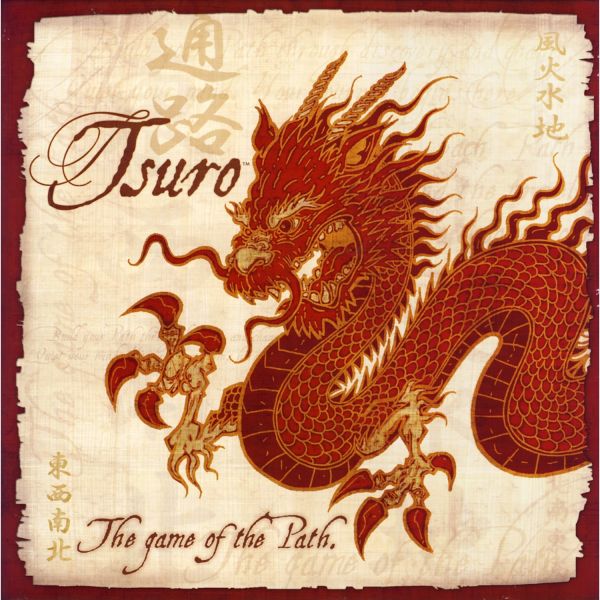
...and for those who don't like long and complicated rules. Tsuro – the Game of the Path is a quick elimination game with simple mechanics that's good for every type of player. Designed by Tom McMurchie and published first by WizKids, it is stripped of scoring and multitasking, assigning the player with one job only: keeping his dragon flying till the end of the game.

Although this is a light game you will need a fair share of strategy if you are to avoid being cornered between dead ends. Dragons are constantly on the move, so creating a path while escaping collisions with one another, while at the same time avoiding to get off the board, can get pretty tricky to manage. Naturally, the difficulty increases the more players are around the table. The more the merrier, so it goes.


Very basic basics

Tsuro only needs to be learned once, and can easily be played without a mock match first. For preparation, every player gets a dragon gamepiece which is placed at one of the lines marking the beginning of a path, at the edges of the square board. There is no right or wrong order to start the placing, as there is no right or wrong place. After the starting points are selected, players are dealt 3 tiles which will constitute their hand. The remaining tiles are to be kept face down and used as deck.

The player's turn has only three sequencial actions:
1 - Placing a tile in front of the player's dragon
2 - Move every dragon adjacent to this tile toward the end of its new path. It doesn't matter if the dragon has to step on previously placed tiles, for the movement only stops when the dragon has no more path in front of it.
3 - The active player draws a new tile from the deck, if there's still one

In the movement phase of the turn, any dragon that gets led to the edge of the board is taken off the game. Similarly, dragons that collide are taken off as well, regardless of which dragon was moving. The tiles of these players go back to the deck. Whichever dragon is the last one standing wins. Should it happen that the last players are eliminated at the same time, these are considered the winners.


Thumbs up

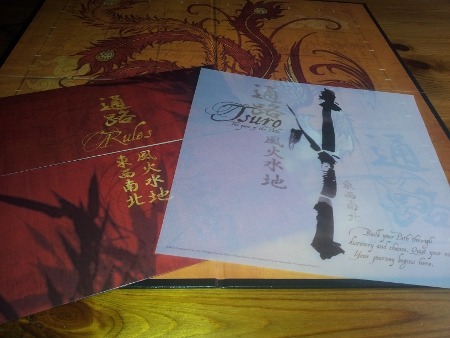
The first thing Tsuro really delivers is the look. Everything in this game is dropdead gorgeous - the box, the thin translucent paper with the title on it, the board... Even the bloody rulebook is beautiful! I mean, have you looked at it? It has kanji on it and opens in the middle! Every tile is unique and creates intricate patterns on the board as the game progresses. It is, without any doubt, a collector's dream.

Image: boardgamegeek.com
However, the value of this game is not merely on the outside. Making the tiles unique is a smart move to improve this game's replay value, since simple mechanics make games feel repetitive, especially if you keep the same player group.

Nevertheless, I think the strongest argument in favor of Tsuro is not any of the above points. It is the basic rules that make it fast to understand. Skip all the 'wait, how was this played again?' and 'I don't get it, I'll just watch' - regardless of age, you can get everyone started right away. Therefore, Tsuro is surprisingly versatile. Families can play it together, from children to people on tight schedules. It can be enjoyed in parties as well as in pubs or cafes. And, even though simplicity can make Tsuro fall short at times, the fact that it's not very demanding feels refreshing enough even after a very tough day.

Last, but not least, not every game allows 8 players to join in at once. It's terrible when you have just one too many for an evening of gaming, right? Taking turns or teaming up is alright with most games, but no one will say no to playing on their own once in a while.


...Meh

Now, you must be thinking: "Dude, it has dragons in it. What's there not to like?". While Tsuro is without any doubt a very fun game to play, I don't think there's anyone out there who would consider it the best game ever. There are times when simplicity is welcome, and there are times when it is not.

Image: 4vp.tumblr.com
Firstly, while there are definitely different ways to approach the game, these can be thrown into one of two categories: offensive gaming and defensive gaming. Defensive gaming lasts longer, but ends less excitingly, while offensive strategies tend to speed things up and get more satisfying endings. Strategists might get annoyed by this game, more so because it's hard to plan ahead when all the tiles are different and you're playing with a lot of people.

One has to bear in mind that Tsuro is optimized for more than 2 players. Albeit it can be played with just the two, the typical two player game is just dragons running away from eachother until one's luck runs out. Since all tiles must be placed in front of a dragon, connected to the previous path, and that dragon started at the edge of the board, by the end of the game nearly every path is connected to the edges. So, one of the players must necessarily be sent off the board, usually the player which started first, or the one with worse tiles.

This means the worse flaw in Tsuro is its lack of a finishing element. With good players and well dealt tiles, it still comes down to who lasts longer. When there are no tiles left it’s only a matter of time. I’ve come to notice that whenever a game ends like this I want to play more and more until there’s an epic match of Tsuro. And great matches like that don't come often, unless you get more people to play with you.


Spicin' it up! 

Every game that gets awarded that special frequently-played spot deserves a bit of tweaking to make it different. Most of them even get their rules changed a bit after years of playing. I've never known anyone who plays Scrabble by the original rules, and the same goes for many other classics.

All in all, Tsuro has the potential to become either a family game or that one game you have for time-outs in the middle of more hardcore tabletop sessions; whatever the case might be, my thinking is that there are small additions that can boost the game and make it more enjoyable. Without further ado, here are my suggested house rules.

Tsuro race edition: as I've said before, any game of Tsuro that lasts up to the last six tiles or so becomes a waiting game. There are so many ways you can go when all paths are connected to an edge, so basically if no one is thrown off, it's a matter of who lasts one round longer than the others. So, we change that and time it to last less - when the deck ends, the game ends, no matter how many tiles there are in the player's hands at that point. What's more, in case there's more than one player standing then, there is no winner. Having to take out the others on a schedule will definitely make games more exciting.

Fight! Fight! Fight!: make a point system, for instance, for every dragon you throw off their path you get 2 points. The point is not to survive, but to get more points. This will get the players running after one another and will speed things up. Another way to do this is to get a betting system - decide on a number of rounds and in each one bet which position you'll finish in. Pay in mind that these house rules also work better with more players. And beware of very competitive players, cause this can turn into a very steamy game!

28/01/2013

A Walk in the Dark


Worth the weight….of 200 MB 

Whereas some titles are better the more developed they are, that doesn’t automatically mean simple games aren’t good. And just like I came to realize after playing a game with one of the most simple setting I have ever seen, just because a game doesn’t have a storyline worthy of a light novel adaptation, doesn’t mean it won’t be an extremely pleasant experience. A Walk in the Dark is an Indie game by Flying Turtle Software that has been present for a while in steam’s Greenlight page. However, at least until it gets enough votes to reach the store, you can get it from its official site for 5€. The soundtrack is also available.


Not your everyday walk

The (short) story begins with little Arielle and her cat Bast happily together in the forest when BAM, an evil looking wizardry creature just flies by and kidnaps Arielle, enveloping the forest with a dark aura. Suddenly, the green forest is turned into a never-ending corridor of obstacles that Bast must overcome in order to save his owner. Simple, no?


Don’t go towards the light…oh wait

So, after the short animation sequence depicting the events described above, we begin the first stage. Needless to say, we control a slender black cat (pretty much everything in this game is black except for the backgrounds) and our objective is to take him to a pillar of light representing the end of the stage, without allowing him to be hurt (no life bar here, if something bad touches you OR if you touch IT, you instantly dissolve into a smoke cloud and are put back at the beginning of the stage). At first there aren’t really any threats to the cat’s integrity except for some spikes here and there, but as you progress through the one hundred stages, things get tricky. Levels get longer and/or more confusing with gravity -changing devices, rotating blades, less safe ground and an increasingly smaller margin for jumping errors.


Gotta go fast

Make it into the light and you get a super simple “stage clear” screen, with your time, your best time and the PAR time. The PAR time is predetermined for all levels, and if you manage to beat it you are awarded with a Speedy badge. This proves to be a simple but extremely effective way to make you want to perfect each level, extending the game’s length. There is also an additional Shiny Badge, awarded if you manage to collect a shiny bauble found in every level, most of them in very tricky spots (just floating above some spikes or similar, making a perfectly executed jump mandatory). Of course you don’t need to get both badges on the same run, in fact you don’t need to get them at all, they’re just “Achievements” of sorts.
Not all levels are the same, some levels title “The Cave” have the cat run forward automatically, leaving you the challenge of jumping or ducking at the right time to avoid death. In my opinion these are the hardest stages.
Since here the cat runs by itself, instead of par time you get a “First Run” should you successfully complete the stage on your first try. Seems a bit buggy though, if you fail your first try, you have to quit the level, load another one and then re-enter the original level in an attempt to do it “on the first try”. And it still doesn’t unlock sometimes.
There are also Arielle’s stages, which follow the same mechanics as Bast’s, except here you move around and press the jump button to invert your gravity as you go over/under obstacles towards the end of each stage. This mechanic is also present in the cat’s stages but it’s only activated by stepping on certain light panels.


100 stages of challenge

All in all, a pretty challenging experience with a decent length (took me 6 hours to finish it with all the badges) and with a well-balanced difficulty increase over the stages. Control-wise it doesn’t get easier than this: analog stick to move, a button to jump and one to duck (as Bast). Arielle doesn’t even have the ducking button so you just move and press the jump button to change gravity, pretty much like in VVVVVV.  Some stages might look near-impossible at first but as you repeat each section again and again you will start to mechanize your button presses, eventually perfecting every jump and timing. The last level especially, takes a while to master.


Shortest credit roll ever

As I see it, A Walk in the Dark is a pleasant and challenging experience that all platforming lovers will enjoy, and the short but brilliant soundtrack fits in perfectly with the game’s setting. Also, did I mention it’s only 5€?